

AI Terms Explained: A Beginner-Friendly Guide to Understanding Artificial Intelligence
- Jurgen Schwanitz

- Jul 23, 2025
- 4 min read

Artificial Intelligence (AI) is everywhere—from your smartphone’s voice assistant to how your email filters spam. But as AI becomes more integrated into our daily lives and business operations, it brings with it a flood of technical terms that can be confusing, even overwhelming.
You’ve probably heard words like machine learning, neural networks, or natural language processing thrown around—but what do they really mean?
This blog will break down the most common AI terms in a simple, easy-to-understand way. Whether you're a business owner, a curious learner, or someone just trying to keep up, this glossary will help you get a better grasp of the AI landscape.
🔹 Artificial Intelligence (AI)
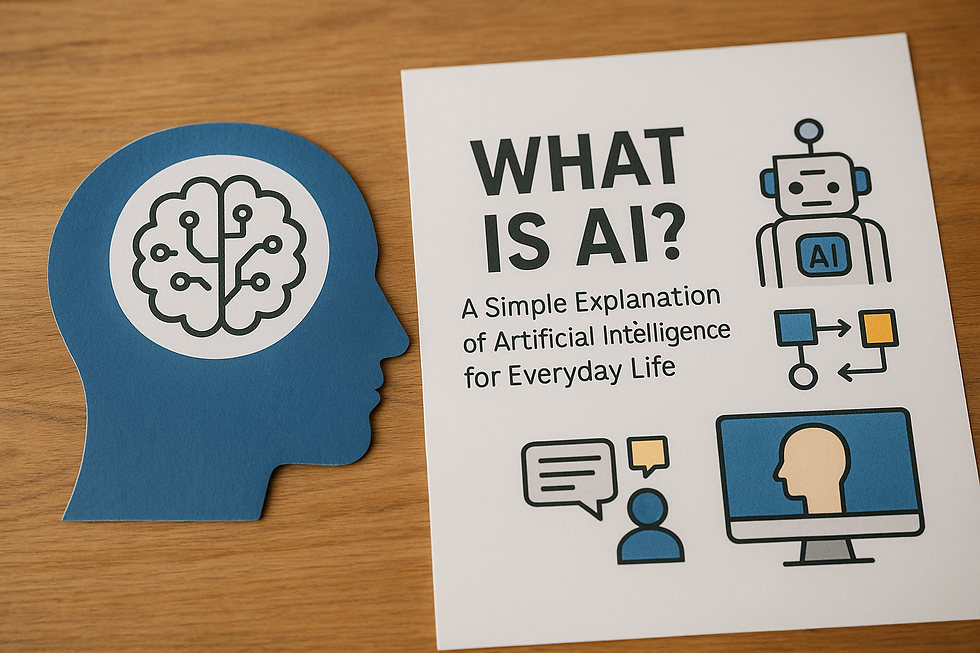
Definition:AI refers to the ability of machines to perform tasks that normally require human intelligence. These tasks include learning, reasoning, problem-solving, understanding language, and even perception.
Example:When your phone suggests a route home or your Netflix account recommends a new series—it’s using AI.
🔹 Machine Learning (ML)
Definition:A subset of AI, machine learning is the process by which a computer “learns” from data without being explicitly programmed. It improves its performance as it processes more data over time.
Example:Spam filters in your email that get better at spotting junk messages based on past examples.
🔹 Deep Learning
Definition:A specialized type of machine learning that uses layered neural networks to analyze large amounts of data and recognize complex patterns.
Example:Facial recognition technology in your smartphone uses deep learning to identify your face from thousands of tiny details.
🔹 Neural Network
Definition:A system modeled after the human brain. Neural networks consist of layers of nodes (also called neurons) that process data and identify patterns.
Example:When AI learns to distinguish between cats and dogs in images, it's using a neural network to process visual information.
🔹 Natural Language Processing (NLP)
Definition:The branch of AI that helps machines understand, interpret, and respond to human language.
Example:Chatbots, voice assistants like Alexa or Siri, and AI tools that summarize or translate text all use NLP.
🔹 Generative AI
Definition:A type of AI that can generate new content like text, images, music, or code based on prompts and training data.
Example:ChatGPT (text), DALL·E (images), and tools that write marketing copy or compose music fall under generative AI.
🔹 Training Data
Definition:The large set of data used to teach an AI model how to perform a task.
Example:An AI that identifies loan fraud may be trained on thousands of past transactions labeled as “fraudulent” or “not fraudulent.”
🔹 Prompt
Definition:In generative AI, a prompt is the input or instruction you give the system to generate a response.
Example:Typing “Write a blog post about AI terms” into ChatGPT—that’s your prompt.
🔹 Model
Definition:The core AI system that has been trained on data and can make predictions, generate text, analyze images, or complete other tasks.
Example:GPT-4 is a language model created by OpenAI. It can generate text, answer questions, and write code.
🔹 Token
Definition:A token is a chunk of text—typically a word or part of a word—that AI uses to process language.
Example:The sentence “AI is powerful” is broken down into tokens like “AI”, “is”, and “powerful.”
🔹 Supervised Learning
Definition:A machine learning approach where the AI is trained using labeled data (the correct answers are already known).
Example:Teaching an AI to recognize cats by showing it thousands of images labeled “cat” or “not cat.”
🔹 Unsupervised Learning
Definition:A type of machine learning where the AI learns from data that has not been labeled, identifying patterns and relationships on its own.
Example:Market segmentation tools that group customers based on similar behavior without being told in advance what the groups are.
🔹 Reinforcement Learning
Definition:A method where AI learns by interacting with its environment and receiving rewards or penalties based on its actions.
Example:Teaching a robot to walk by rewarding it when it makes progress and penalizing it when it falls.
🔹 Bias in AI
Definition:Bias occurs when an AI system produces skewed or unfair results due to imbalanced or flawed training data.
Example:A hiring algorithm trained mostly on resumes from male candidates might unfairly favor men over equally qualified women.
🔹 Algorithm
Definition:A set of rules or instructions that a computer follows to perform a task or solve a problem.
Example:Google’s search engine uses an algorithm to rank web pages based on relevance.
🔹 Turing Test
Definition:A test of a machine’s ability to exhibit intelligent behavior indistinguishable from that of a human.
Example:If you chat with an AI and can’t tell whether it’s a human or a machine, it has passed the Turing Test.
🔹 API (Application Programming Interface)
Definition:A tool that lets two software programs communicate. In the context of AI, it allows developers to plug into an AI model to use it within their own apps.
Example:A developer might use OpenAI’s API to integrate ChatGPT into a customer support platform.

Comments